Among the many antelope species that grace the savannas and forests of Africa, the sitatunga (Tragelaphus spekii) remains one of the most enigmatic. Often shrouded in the tall reeds of swamps and marshes, this semi-aquatic antelope is specially adapted to a life where most others would sink, both literally and figuratively. With its unique physical adaptations, subtle behavior, and deep connection to wetland ecosystems, the sitatunga offers a fascinating case study in evolution and ecological specialization.

Unlike impalas or gazelles, which bound across the open plains of Queen Elizabeth or graze openly in woodlands, the sitatunga has retreated into the wetlands, a place often inaccessible to predators and humans alike. Its shaggy, water-repellent coat and long, splayed hooves are not just physical peculiarities but evolutionary tools crafted for a world of mud, reeds, and standing water. In appearance, it may resemble its closest relatives such as the bushbuck or the bongo, but its lifestyle is utterly distinct.
In Uganda, where rich wetlands interlace with dense forests and grasslands, the sitatunga thrives in pockets of hidden wilderness. From the shores of Lake Kyoga to the papyrus-lined fringes of the Nile River, this shy antelope plays an understated but vital role in the health of aquatic ecosystems. The sitatunga helps maintain the delicate balance of wetland plant growth by grazing on water plants and sedges, indirectly supporting habitats for birds, amphibians, and insects.

Yet the sitatunga is also a symbol of vulnerability. As wetlands across Africa are increasingly drained for agriculture and human settlement, the natural strongholds of the sitatunga are shrinking. These changes threaten not only this unique antelope but also the entire ecosystems it helps sustain.
Still, the sitatunga’s secretive nature and adaptability give conservationists hope. With the right attention, this graceful creature can become a flagship species for wetland conservation across East and Central Africa. But what truly sets the sitatunga apart from its dryland relatives? How does it live, reproduce, feed, and survive in such an unusual habitat?
Let’s journey into the life of the sitatunga, beginning from the moment of its birth.
Reproduction, Birth, and Early Life
The birth of a sitatunga is not an event many people witness, and that is precisely how nature intended it. Born deep within the papyrus-choked wetlands, a sitatunga calf enters the world hidden away from predators and the outside world. The mother chooses secluded, water-logged vegetation to give birth, thick beds of grass or floating islands of reeds where she can remain undetected.
Sitatunga gestation lasts approximately 7 to 8 months. Females generally give birth to a single calf, though on very rare occasions, twins may occur. Weighing between 4.5 to 6.8 kilograms at birth, the calf is surprisingly sturdy but remains motionless and hidden for much of the first few weeks of life. This behavior, known as “hider” strategy, is common among forest antelopes like the bushbuck, in contrast to the more gregarious and mobile young of open-country species like Thomson’s gazelle.
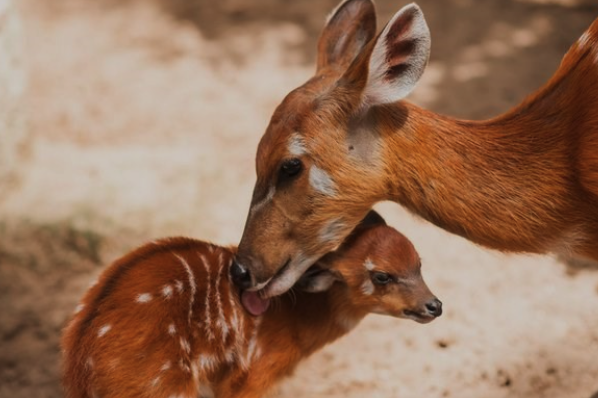
The calf’s reddish-brown coat is dappled with vertical white stripes that offer natural camouflage among the shafts of papyrus and tall grasses. Its scent glands are undeveloped at birth, a strategic evolutionary choice to avoid attracting predators through smell. The mother will nurse the calf quickly and then leave it concealed in vegetation, only returning periodically to feed and groom it. This pattern continues for up to six weeks.

By the second or third week, the calf begins nibbling on vegetation, mimicking the mother’s foraging habits. Full weaning, however, takes several months, often up to six months or more, by which time the young sitatunga will be agile in the water and capable of traversing swamps with growing confidence.

Mortality rates among calves are relatively high, with birds of prey, snakes, and occasionally leopards posing threats, particularly in fragmented or degraded habitats where hiding spaces are reduced. However, the sitatunga’s evolutionary strategy of concealment, combined with the inaccessibility of its swampy birthing grounds, helps mitigate many of these threats.

Sexual maturity in female Sitatungas is reached between 12 and 14 months, while males may take up to 18 months before they are fully grown and capable of defending territory or pursuing mates.
What makes sitatunga reproduction especially intriguing is that it is not rigidly seasonal. While many savanna antelopes time their births to the rainy season when food is plentiful, sitatungas can breed year-round. The consistency of wetland resources means that females may conceive again shortly after weaning a calf, maintaining stable population dynamics even in the absence of seasonal breeding cues.
Thus, from its very first moments, the sitatunga calf is a creature of stealth, water, and quiet strength, emerging not with a sprint into the sun-drenched plains but with a silent breath into a shadowed marsh, where survival hinges on invisibility.
Habitat
The sitatunga is one of the few large African herbivores whose survival is intimately linked to wetland habitats. Unlike most antelopes that prefer grasslands, dry forests, or savannas, the sitatunga is almost exclusively found in freshwater swamps, marshes, floodplains, and the thick papyrus beds that fringe lakes and slow-moving rivers. These environments provide both food and refuge, enabling the sitatunga to avoid predators and thrive where others struggle to survive.

Their range stretches across Central Africa and parts of East Africa, including countries such as Uganda, South Sudan, the Democratic Republic of Congo, Cameroon, Tanzania, and Zambia. While some isolated populations exist in West Africa, it is the extensive and often inaccessible swamplands of East and Central Africa that serve as the species’ strongholds.
In Uganda, sitatungas are relatively widespread though rarely seen. They occur in wetland habitats around Lake Kyoga, Lake Bisina, the Nile River, the Sudd region of northern Uganda, and in protected areas like Semliki National Park, Murchison Falls National Park, and the Mabamba Swamp, famously known as a birdwatcher’s paradise but also home to this antelope. They are also known to inhabit the Bigodi Wetlands near Kibale and the shores of Lake Albert.

The key to their survival in these habitats lies in their physical and behavioral adaptations. Their long, splayed hooves prevent them from sinking into marshy ground, and their powerful hind legs help them wade, walk, or even swim through deep water. Sitatungas are excellent swimmers and will often dive into water to escape danger, submerging themselves with only their nostrils above the surface.

Sitatungas require dense cover to feel secure. They prefer areas dominated by papyrus, sedges, reeds, and thick aquatic grasses that offer both food and concealment. Unlike many savanna antelopes that rely on speed, sitatungas depend on invisibility and stealth. They create well-trodden tunnels through dense vegetation, called “hippo paths” or “sitatunga channels,” which are used repeatedly and help them move silently through the swamp.
However, this specialized habitat preference also makes them extremely vulnerable to environmental changes. The drainage of wetlands for agriculture, overgrazing by livestock, and pollution from industrial runoff threaten the delicate ecosystems they rely on. In Uganda, wetland degradation is accelerating due to population growth and land pressure, placing additional stress on sitatunga populations.
Feeding Habits and Diet
Sitatungas are strictly herbivorous, with their diet finely tuned to the resources available in their wetland environment. This dietary specialization allows them to exploit a food niche that few other large herbivores utilize. During the early morning and late evening hours, sitatungas emerge from deep cover to feed at the edges of clearings or on floating vegetation mats. These twilight hours offer the best combination of safety and access to fresh plant growth.

One unique trait in their feeding behavior is selective browsing; sitatungas are known to choose the most nutrient-rich parts of plants, such as tender shoots and new leaves, leaving behind tougher, older foliage. This ensures optimal energy intake while also minimizing digestive strain. Their four-chambered stomachs, much like those of cattle, allow them to process high-fiber vegetation efficiently through microbial fermentation.
In times of water fluctuation, when wetlands partially dry up or water levels fall, sitatungas adapt their foraging strategy. They may range slightly further to access seasonal grasses or succulent herbaceous plants growing on the exposed mudflats. During floods, they rely more on floating vegetation and submerged shoots, using their long muzzles and flexible lips to grasp and strip vegetation below the water’s surface.
Interestingly, sitatungas are known to avoid competition with sympatric species such as the waterbuck or kob by sticking to areas of deeper marshes where these other species rarely venture. This microhabitat separation helps maintain ecological balance and reduces interspecies rivalry over resources.
While their feeding habits rarely bring them into direct conflict with humans, habitat degradation caused by human activity can lead to food scarcity. When wetlands are drained or invaded by invasive plant species, the composition of available forage changes, potentially impacting sitatunga nutrition and reproductive success.
Subspecies and Types
Though the sitatunga may appear as a single species at first glance, it occurs in a variety of subtly distinct forms across its wide range. Scientists generally recognize several subspecies of sitatunga (Tragelaphus spekii), primarily differentiated by geography, coat coloration, size, and horn shape. These subspecies are not always sharply defined, and natural intergradation occurs in areas where populations overlap.
- Nile Sitatunga (T. s. gratus) – Found primarily in Uganda and South Sudan, this is the most encountered subspecies in East Africa. Males are dark chocolate-brown with sharply spiraled horns and faint vertical body stripes, while females are reddish-brown with more prominent striping. This subspecies thrives in papyrus swamps and slow-flowing river systems, particularly along the Nile and in central Uganda’s wetland mosaics.
- Kafu Sitatunga – Though not officially designated as a separate subspecies, the sitatungas found in the Kafu River Basin of western Uganda often exhibit slightly different characteristics: shorter horns, denser fur, and deeper chestnut tones. These localized traits may be due to habitat fragmentation or environmental pressures unique to this region.
- Congo or Forest Sitatunga (T. s. spekii) – Native to the central Congo Basin and surrounding lowland rainforest wetlands, this subspecies is generally darker and woollier, with reduced striping. Adapted to shadier, denser environments, they are even more secretive than their East African relatives.
- Zambian Sitatunga (T. s. selousi) – Found in the floodplains of Zambia, Angola, and parts of Botswana, this subspecies has lighter, more grayish-brown coats and longer horns with broader spirals. Their range includes the Bangweulu Swamps and the Kafue Flats, where they are sometimes more visible than in forested environments.
While genetic studies are still ongoing to clarify the evolutionary relationships between these populations, these regional differences speak to the sitatunga’s remarkable adaptability. Wherever it is found, the sitatunga blends into its surroundings so perfectly that even seasoned guides describe it as one of Africa’s most elusive antelopes.
In Uganda, where multiple wetland systems converge across diverse elevations and ecosystems, the Nile sitatunga continues to puzzle biologists with its fragmented but persistent populations. Some researchers speculate that these local groups have developed unique traits in response to isolated wetland “islands,” forming a patchwork of micro-evolutionary stories within a single nation.
Understanding these subtle regional variants isn’t just a matter of taxonomy, it’s essential for conservation. Protecting sitatungas requires acknowledging these localized differences in habitat needs and vulnerability. A swamp in western Uganda may require a different management approach than one in the Albertine Rift or Nile Delta.
Unique Adaptations and Behaviors
What truly makes the sitatunga stand out among Africa’s antelopes is its unique suite of adaptations for wetland life:
1. Splayed, Elongated Hooves
The sitatunga’s hooves are long and widely splayed, allowing it to move silently and efficiently through soft, waterlogged terrain. This feature helps prevent them from sinking in the mud.
2. Oily, Water-Repellent Coat
Their shaggy coat has a water-repellent quality, helping them stay warm and dry while swimming or wading.
3. Excellent Swimmers
Unlike most antelopes, sitatungas can swim with ease and often evade predators by slipping quietly into the water, where they can submerge almost completely with only their nostrils exposed.
4. Cryptic Behavior
Sitatungas are shy and crepuscular (most active at dawn and dusk). They freeze rather than flee when alarmed, relying on their environment to obscure them from view.
Conservation Status and Population in Uganda
In Uganda:
Estimates suggest a population of about 10,000–15,000 sitatungas, though precise numbers are difficult to obtain due to their elusive nature. Protected areas and community-led conservation zones have become vital refuges for the species.
Major threats in Uganda include:
- Wetland reclamation for rice farming
- Human settlement and livestock grazing
- Poaching, though not as intense as in open savannas
Conservation programs at Zziwa Rhino Sanctuary and Bigodi Wetlands Community Project have integrated sitatunga protection with ecotourism, education, and habitat preservation.
A Symbol of Wetland Conservation
More than just a biological curiosity, the sitatunga is a bellwether species for the health of Africa’s wetlands. Its continued existence is intimately tied to the protection of these delicate ecosystems, which also serve as water filters, carbon sinks, and biodiversity hotspots.
In Uganda, the sitatunga can become an emblem of sustainable tourism. Birders, ecologists, and nature lovers are increasingly interested in “swamp safaris” that showcase species like the shoebill stork and the sitatunga. With increased attention to wetland conservation under Uganda’s environmental policies, the sitatunga may yet thrive alongside growing human populations, if managed wisely.